Closing Line Value: The Only Scoreboard That Doesn't Lie to You
Closing Line Value — CLV — is the metric that cuts through that noise. It's the discipline behind how RealLine thinks about fair value, and it's worth understanding whether or not you ever place a bet.
By RealLine Staff
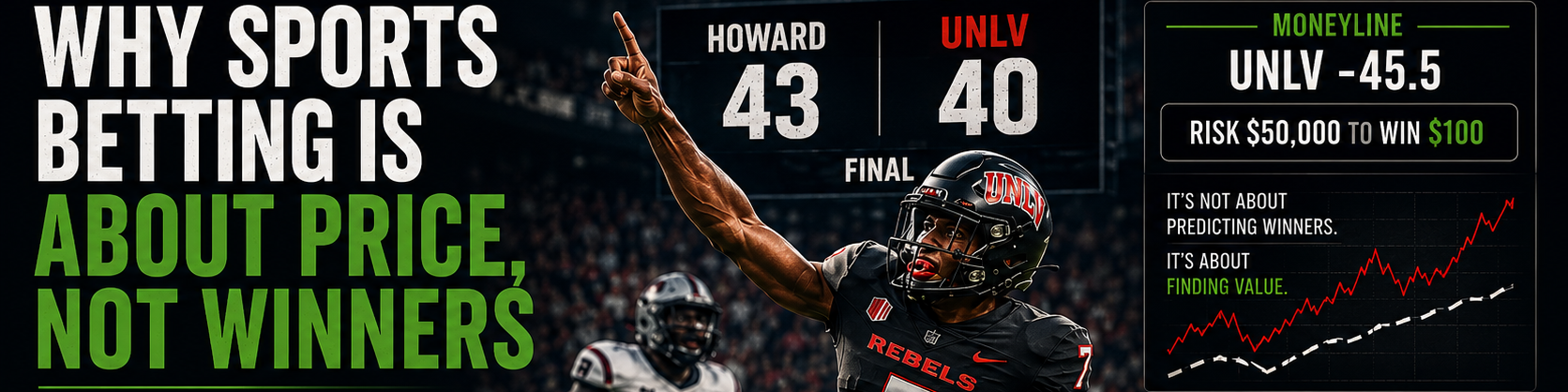
Most people measure their sports analysis the way you'd measure a coin flip over a single afternoon: by whether it won. That feels intuitive, but it's the wrong instrument. Outcomes are noisy. A well-reasoned position can lose, a careless one can win, and over any short stretch the results tell you almost nothing about the quality of the process that produced them.
What CLV actually measures
Every market has a closing number: the final price on a game right before it starts. CLV compares the price you could have acted on earlier against that closing price. If you identified a side at a number more favorable than where the market eventually settled, you captured positive CLV. If the market moved against your side by the close, your CLV was negative.
The key word is market. The closing line isn't one bookmaker's opinion — it's the aggregated result of enormous volume, sharp money, and information flowing in right up to game time. By the time a liquid market closes, it has absorbed roughly everything knowable about that game.
Why the closing line is the benchmark to beat
Here's the empirical reason CLV matters so much: in liquid, well-traded markets, the devigged closing line is remarkably well-calibrated to what actually happens. Strip out the bookmaker's margin, and the closing probabilities line up closely with realized long-run frequencies. Games priced as 60% winners win close to 60% of the time. That calibration is not a marketing claim — it's a repeatedly observed property of markets with enough volume and enough sharp participation.
That makes the closing line the toughest, fairest benchmark available. If your analysis consistently identifies value before the market gets there — if you're routinely on the right side of where the line moves — you are, by definition, extracting information faster than the market prices it in. And if your positions consistently drift the wrong way against the close, that's a signal worth taking seriously, no matter what the win-loss record says in the moment.
Why outcomes lie and CLV doesn't
Consider two scenarios. In the first, you take a side at +150 that the market closes at +115 — meaning the number moved sharply in your favor — and the game loses. In the second, you take a side at -110 that closes at -140, and it wins.
The instinct is to feel good about the second and bad about the first. CLV says the opposite. The first case is a well-timed read that ran into variance; the second is a position the market disagreed with that happened to cash. Repeat each a thousand times and the first process makes money while the second bleeds it. Results over a small sample reward luck. CLV rewards the read.
This is why sample size is everything. A single game, a single week, even a single month — these are far too small to separate signal from noise on outcomes alone. CLV gives you a read on process quality long before your win-loss record becomes statistically meaningful.
How this shapes RealLine
RealLine is built around fair value, not opinions. The platform surfaces where the market is pricing a game relative to a calibrated estimate of fair value — above it, below it, or in line — and leaves the decision entirely to you. We don't sell picks, and we never will.
CLV is the reason that design makes sense. A fair-value number is only worth anything if it can be held accountable, and the closing line is the accountability. A fair-value estimate that reliably anticipates market movement is doing its job; one that doesn't is a number worth questioning. Building the platform this way means our output is measurable against the same benchmark professional markets use to measure themselves.
We think that's the honest way to do sports analytics. No promises about outcomes — nobody can make those truthfully. Just rigorous fair value, and a benchmark that will tell you the truth about it over time.
The takeaway
If you take one idea from this: stop grading your analysis by whether last night won. Start asking whether you were on the right side of the close. It's a harder standard, it's less emotionally satisfying, and it's the only one that survives contact with the math.