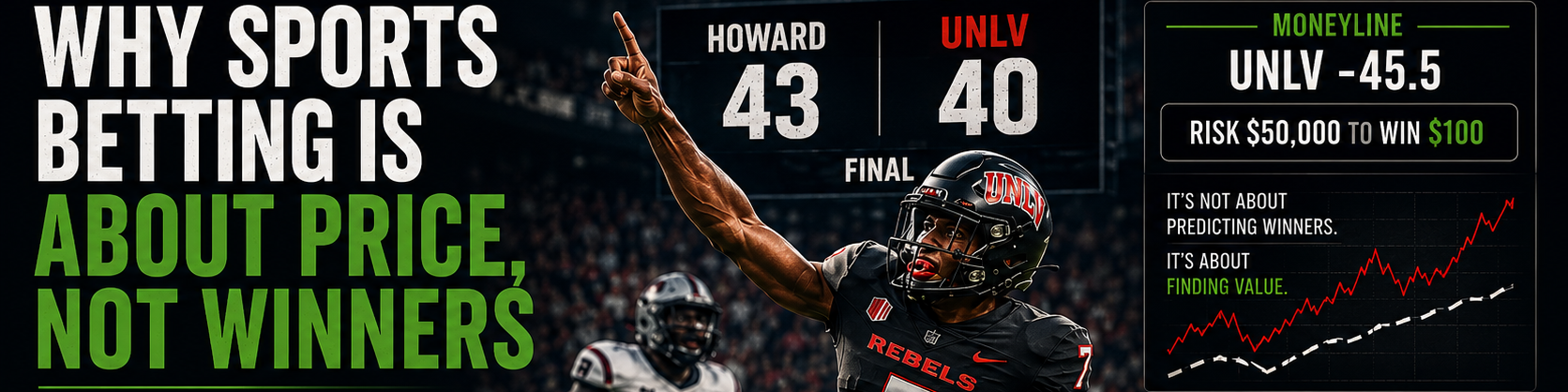
Why Sports Betting Is About Price, Not Winners
A bettor can win 55% of their bets and still lose money long term if they consistently take bad prices.
By RealLine Staff
There’s No Such Thing As a Lock
On September 2, 2017, the University of Nevada, Las Vegas was favored by 45.5 points over Howard University. Depending on the sportsbook, bettors had to risk anywhere from $50,000 to $55,000 just to win $100 on the moneyline.
To most people, that sounds absurd. Why would anyone risk that much money for such a small return?
Because in sports betting, people often confuse high probability with guaranteed outcome.
UNLV was considered virtually unbeatable. Howard was an FCS program facing an FBS opponent on the road. The market implied UNLV had roughly a 99% chance to win the game.
But pay close attention to that number.
It was never 100%.
Howard shocked the college football world with a 43-40 upset behind quarterback Caylin Newton — younger brother of former NFL MVP Cam Newton — who accounted for over 330 total yards and 3 touchdowns.
Every bettor holding a UNLV moneyline ticket learned the same lesson the hard way:
There is no such thing as a lock.
And more importantly:
A team being likely to win does not automatically make the bet profitable.
Money(line) Talks
The Howard upset is an extreme example, but it illustrates one of the most misunderstood concepts in sports betting:
Every wager has a price where it becomes mathematically unprofitable.
Sports betting is not about simply predicting winners. It is about determining whether the price being offered is worth the risk.
That distinction is everything.
If two evenly matched teams played on a neutral field, the theoretical odds would be close to even money on both sides. But sportsbooks are not static. As money and information enter the market, prices adjust continuously.
A team may be exactly the same as it was five minutes earlier:
same roster
same injuries
same weather
same matchup
Yet the value of the wager may have completely changed.
That is how markets work.
The average bettor asks:
“Who’s going to win?”
Professional bettors ask:
“Is this price accurate?”
Those are two completely different questions.
Understanding Implied Probability
Every betting line represents an implied probability.
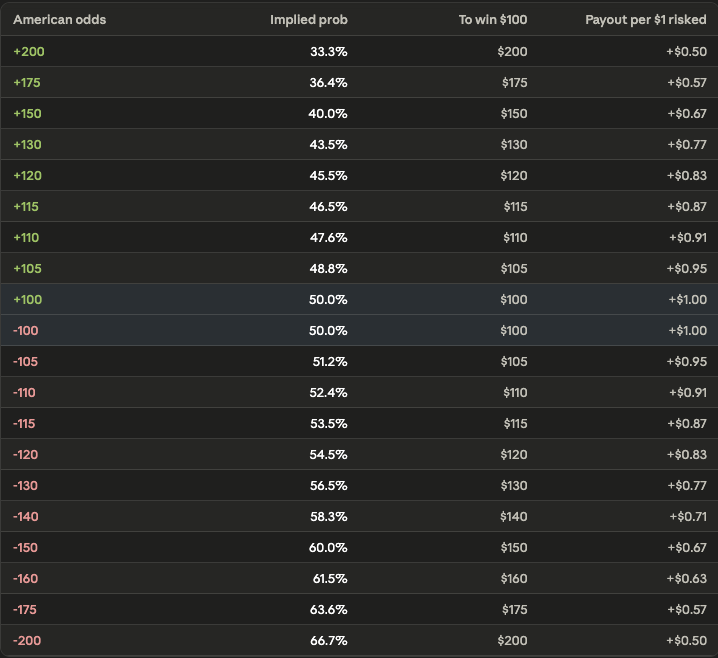
At -125 odds, you must win 55.6% of your bets just to break even.
At +125 odds, you only need to win 44.4%.
That difference is why long-term profitability is driven by price, not simply by picking more winners.
A bettor who consistently lays bad prices can win more games overall and still lose money long term.
Meanwhile, another bettor may win fewer bets but generate profit because they consistently obtain favorable market prices.
That is the foundation of expected value.
Winning Bets vs. Profitable Bets
One of the biggest mistakes recreational bettors make is evaluating themselves solely by win percentage.
A bettor hitting 70% of heavy favorites at terrible prices may actually be losing money.
Meanwhile, a bettor hitting 46% on plus-money underdogs could be highly profitable.
Why?
Because sportsbooks do not pay based on how often you win.
They pay based on the odds attached to each outcome.
If you risk $500 repeatedly to win $100, eventually one loss wipes out multiple wins.
This is why sportsbooks love public favorites:
popular teams
prime-time favorites
inflated parlays
“safe” moneyline combinations
The public gravitates toward perceived certainty.
Sharp bettors gravitate toward mispriced probability.
Those are not the same thing.
The Market Is Smarter Than Most Bettors
As betting markets mature, sportsbooks and sharp bettors collectively shape more efficient pricing.
This is why closing line value (CLV) matters so much.
If a bettor consistently beats the closing number, they are usually making strong long-term decisions regardless of short-term variance.
For example:
If you bet a team at +190 and the market closes +170, you obtained a significantly better price than the consensus market eventually settled on.
The result of the game does not change that fact.
You can lose a good bet.
You can win a bad bet.
But over thousands of wagers, price matters.
Always.
Long-Term Thinking
Professional bettors do not survive by chasing locks.
They survive by consistently finding situations where the implied probability offered by the sportsbook differs from their own estimated probability.
That edge may be small:
2%. 3%. 5%.
But over hundreds or thousands of bets, those small edges compound.
This is the same principle used in:
Financial markets
Poker
Trading
Quantitative investing
Sports betting is simply another probability market.
The goal is not perfection.
The goal is obtaining the best of the number more often than the market expects.
Final Thoughts
The average bettor treats sports betting like prediction.
Sharp bettors treat it like pricing.
That difference is what separates entertainment from long-term profitability.
At RealLine, our focus is not simply identifying who is more likely to win. Our focus is identifying when the market price differs materially from modeled probability.
Because in the long run, price is everything.

